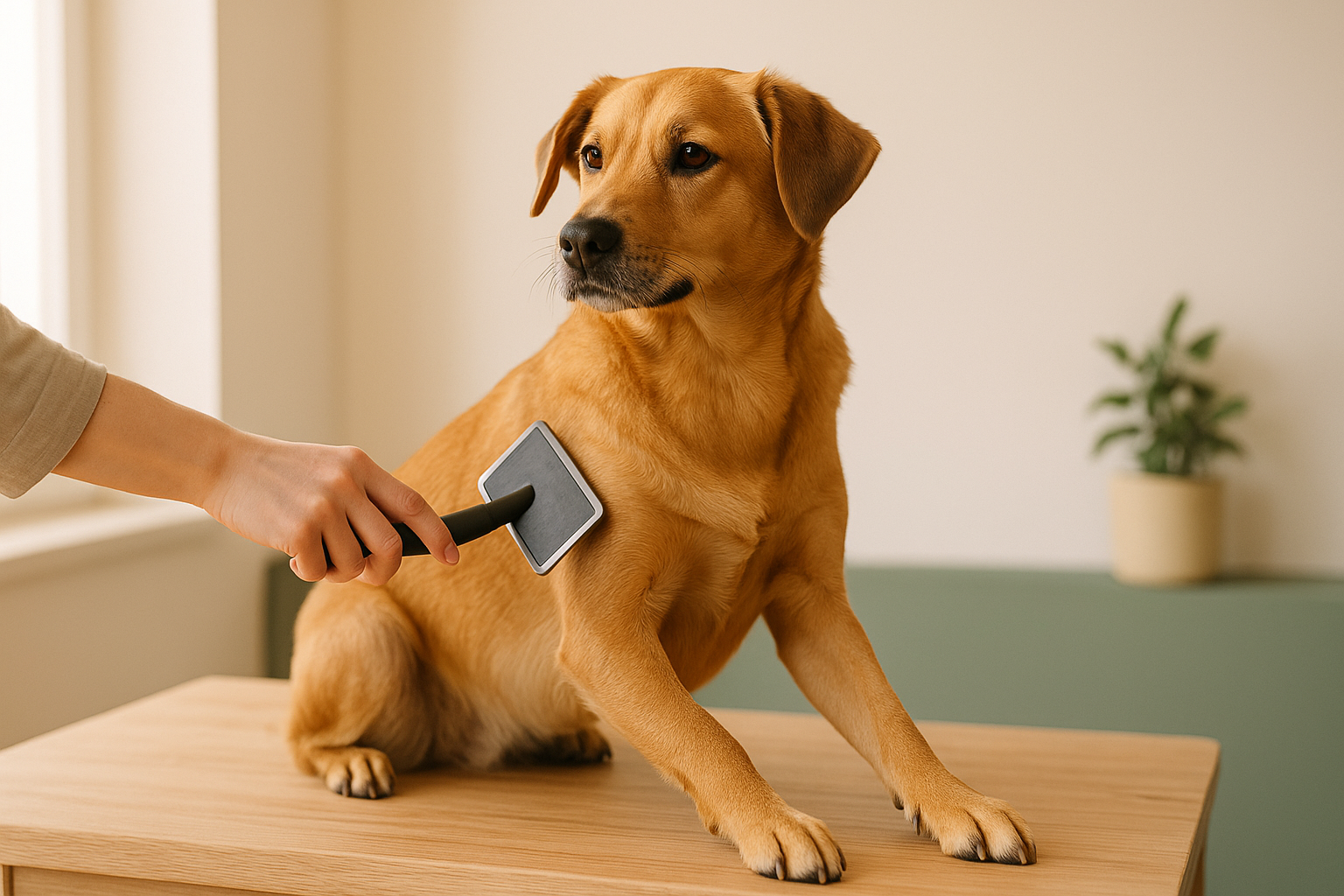
Most dogs who fight the brush were not always like that. Somewhere along the way the brushing became uncomfortable — too much pulling, the wrong tool for the coat, or sessions that started when the dog was already tired. The good news is that most dogs can be brought around with a few changes.
This guide covers what to use, how to approach it, and how to build a routine that does not require two people and a treat bag the size of a small pillow.
Which brush for which coat
The single most common mistake is using a slicker brush on a short-coated dog. Slicker brushes — the ones with fine bent wire pins on a flat pad — are designed to detangle and remove loose undercoat from medium to long coats. On a Labrador or Boxer they will scratch the skin without doing much for the coat.
Here is a rough guide by coat type:
- Short, smooth coats (Boxer, Vizsla, Greyhound): A rubber curry comb or a dense bristle brush. These lift loose hair and distribute skin oils without irritating. A weekly five-minute session is usually enough.
- Double coats (Golden Retriever, Husky, Malamute): An undercoat rake for the thick undercoat, followed by a slicker brush for the top layer. Focus particularly on behind the ears, under the armpits, and around the collar — these are where mats form first.
- Curly or wavy coats (Poodle crosses, Lagotto): A wide-tooth comb and a slicker brush. Curly coats trap dead hair rather than shedding it, so they mat faster than you expect. Three to four brushing sessions per week is realistic if you want to avoid professional de-matting.
- Wire coats (Terriers, Schnauzers): A slicker brush and a stripping comb if you do hand-stripping. Most owners clip rather than strip, and the salon can advise on what works for your specific breed.
How to approach a dog who resists
Do not start with the problem area. If your dog tenses when you approach the back legs, start with the back. Build up a positive association with the brush being present before you use it on anything difficult.
Keep the first sessions very short — two to three minutes at most. A dog who ends a session in a relaxed state has learned something useful. A dog who endures twenty minutes of brushing and finally squirms free has learned that persistence eventually works.
Use a non-slip mat on the table or the floor. A dog who feels unsteady is a dog who will try to get off. Stable footing makes a real difference.
If your dog has a trigger point — one area they reliably object to — do not skip it, but do save it for the middle of the session, not the beginning or end. You want the session to start and finish calmly.
Technique: brush with the coat, not across it
Brush in the direction the coat lies, working in sections from the skin outward. If you only brush the surface of a long coat you will smooth the top layer while mats continue building underneath — which is exactly where they will not be visible until they are severe.
Part the coat gently with your free hand and work the brush from skin to tip in short strokes. For double-coated breeds, two passes usually makes sense: one with the undercoat rake or Furminator-style tool, then one with the slicker brush to finish the surface.
If you hit a mat, hold the base of the mat firmly with your fingers before you try to brush it out. This takes the tension off the skin. Work from the outside of the mat inward, teasing small sections apart rather than dragging the whole thing. Detangling spray helps. If the mat is tight to the skin, do not force it — a small pair of blunt-nosed scissors can help cut through the base, but if you are not confident, leave it for the salon.
How often is realistic
Frequency depends on coat type more than breed. Short smooth coats genuinely only need weekly attention. Curly and double coats realistically need three to four sessions per week to stay mat-free between professional grooms.
The goal of home brushing is not to replace professional grooming — it is to maintain the coat between sessions so that when the dog comes in, we are dealing with a clean, brushed coat rather than spending half the appointment on detangling.
If you are unsure how often your specific dog needs brushing, ask us when you book — we will tell you what we see on the coat each visit and what makes sense to do at home.